Research
Ongoing Projects
This section highlights the projects I am currently working on. For a comprehensive overview of my completed and prior work, please refer to my CV.
INFORMES: INtermodal Freight Optimization for a Resilient Mobility Energy System
Funding Sources: U.S. Department of Energy Advanced Research Projects Agency – Energy (ARPA-E); project led by the National Renewable Energy Laboratory (NREL)
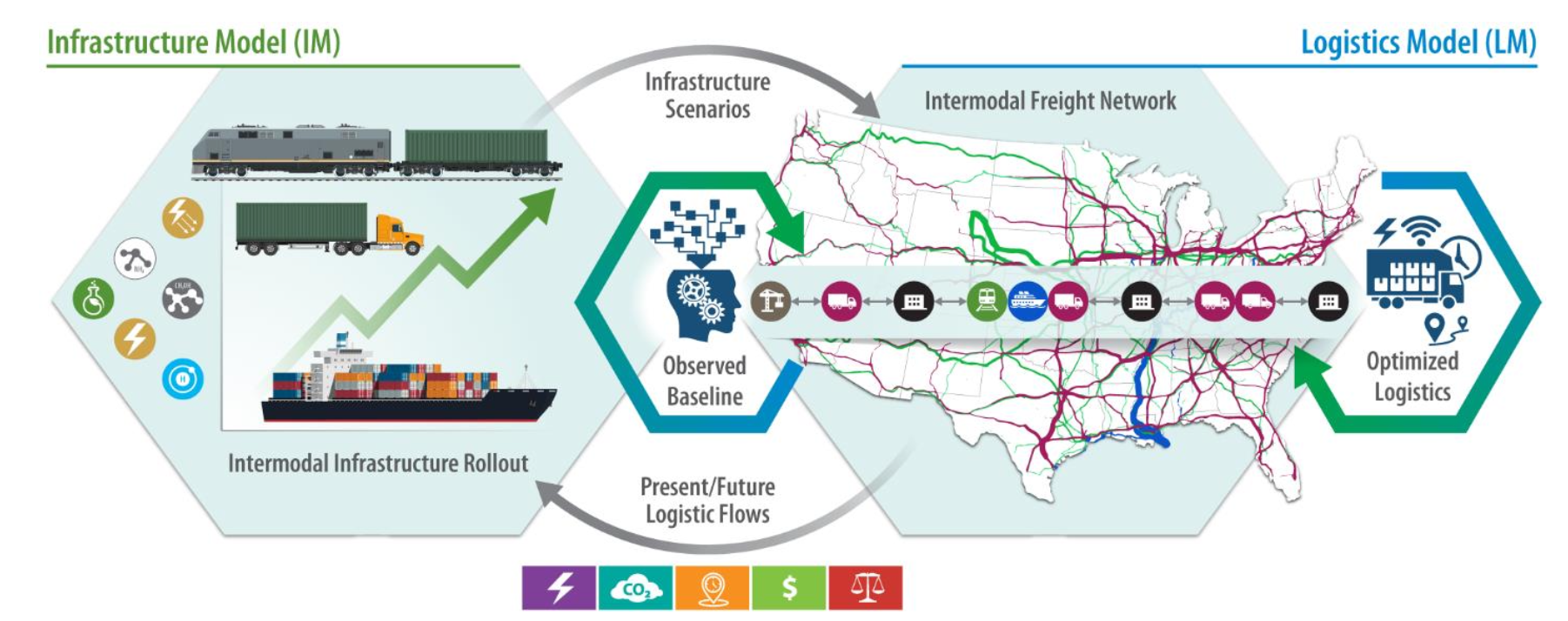
INFORMES proposes to develop a national-level intermodal freight modeling framework to support decision-making in the execution and rollout strategy of decarbonization technologies and guide efficient operations of the intermodal freight system. We are developing an Infrastructure Model (IM) and a Logistics Model (LM), and integrate them in a Python-based, easily executable and publicly distributable software tool. The IM is designed to model deployment of low-carbon energy sources and systems, transshipment terminals, and emerging vehicle operations, and find the optimal spatial and temporal allocation of resources. The LM generates a robust and holistic optimization of intermodal logistics operations simulating intermodal demand on top of the stochastic transportation system. INFORMES develops a national-level intermodal freight modeling framework to support strategic decision-making for the deployment and operational planning of freight decarbonization technologies. The project aims to guide efficient, resilient operations of the intermodal freight system under emerging energy and mobility paradigms.
Code repositories: ALTRIOS , LIFTS
Developing a Multi-Modal Maritime–Rail–Road Transportation Model for Texas Inland and Intercoastal Waterways
Funding Sources: Texas Department of Transportation (TxDOT); project led by the SPARTA Lab of Dr. Stephen Boyles
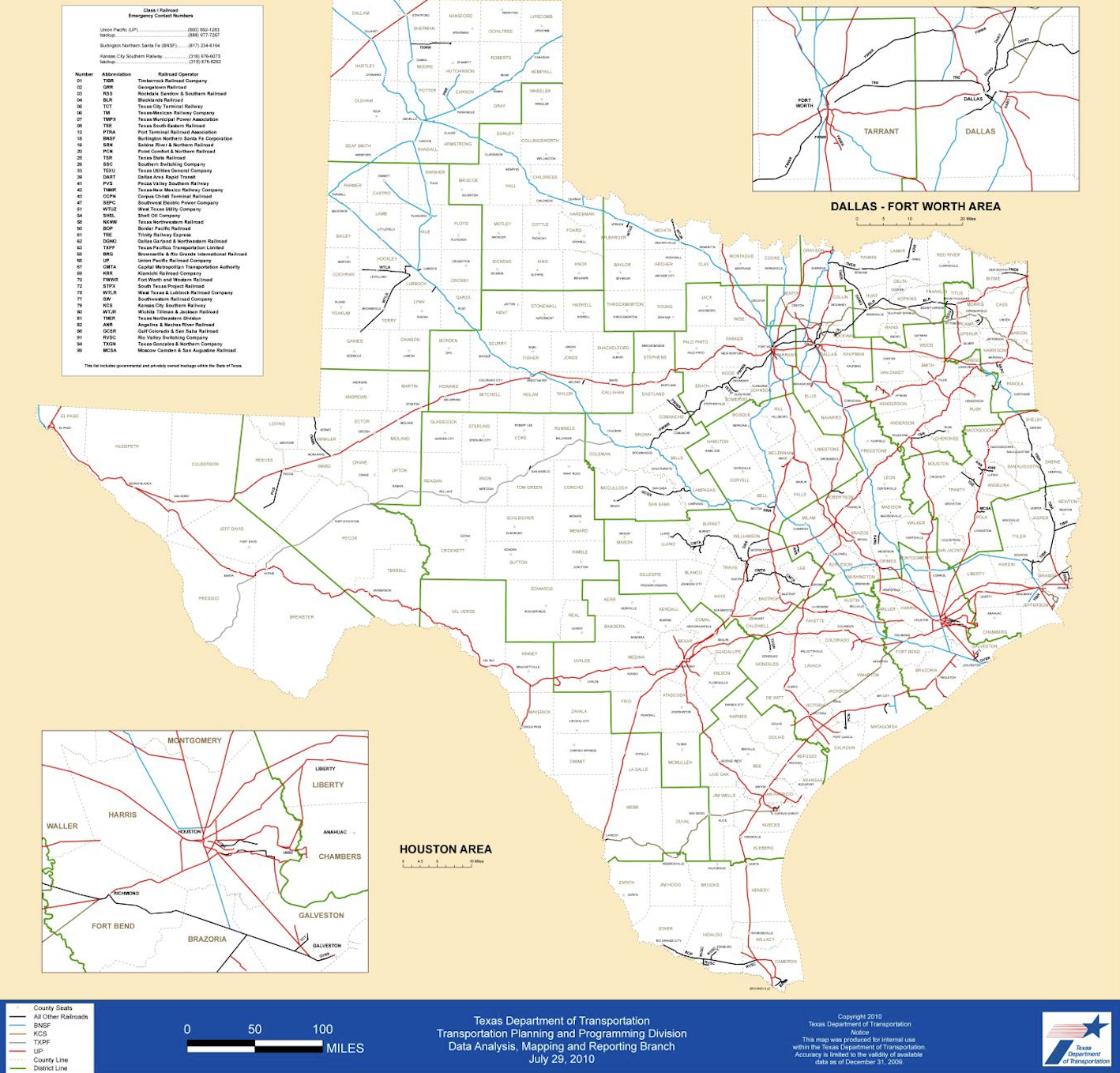
This project establishes a statewide multimodal freight modeling framework that integrates maritime, rail, and roadway systems to evaluate commodity flows, infrastructure capacity, and system-level performance across Texas inland and intercoastal waterways. The research synthesizes diverse Texas freight datasets to characterize statewide commodity movements, network topology, and capacity constraints. A network-based discrete-event simulation framework is developed to support multimodal routing and scheduling under time-dependent and uncertain operating conditions, incorporating customized algorithms and uncertainty-aware representations of disruption, risk, and infrastructure vulnerability. The resulting insights support freight planning, infrastructure investment prioritization, and resilience assessment for complex multimodal transportation systems.